

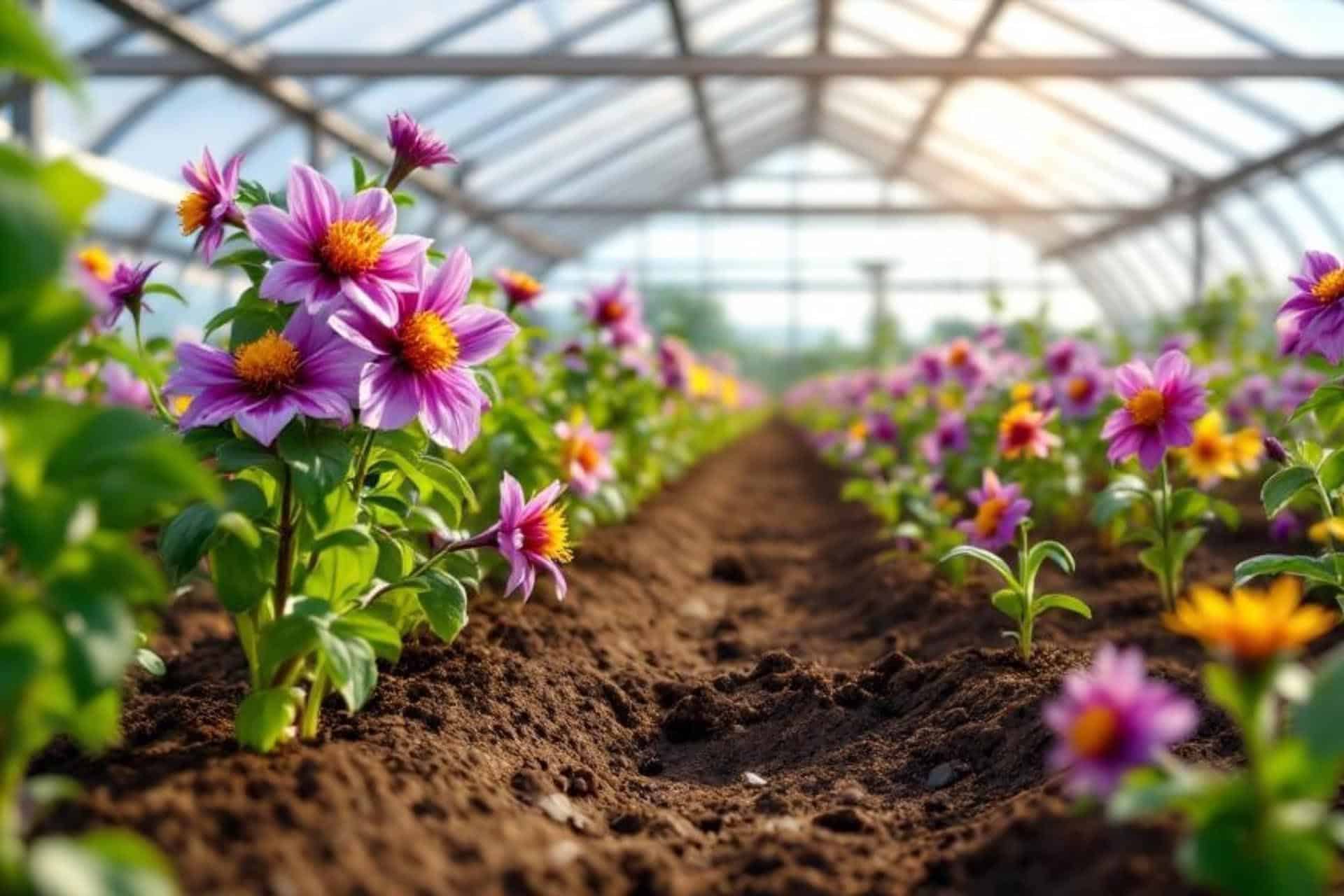
Saffron greenhouse cultivation (Aeroponic and Hydroponic Saffron Cultivation) has gained global popularity in recent years and is implemented in various countries. This plant can be cultivated in various greenhouse structures. However, the question always arises: which is better between greenhouse saffron cultivation and soil-based saffron cultivation? In this article, we examine the advantages and disadvantages of greenhouse saffron cultivation to assist your decision-making process regarding cultivation methods. [Click here to learn about saffron greenhouse income at different scales].
What Type of Plant is Saffron?
The well-known saffron plant, historically called “Karkamis” in ancient dialects and “Karkaminsa,” is one of the world’s most expensive spice and medicinal plants. This perennial plant belongs to the Iridaceae family, featuring a purple flower with three petals, three sepals, three yellow stamens, and a three-branched dark red stigma. Its scientific name is Crocus sativus.
History of Saffron Cultivation
Saffron is intrinsically linked to Iran and primarily grows in the country’s arid and semi-arid regions. Some trace the cultivation of “red gold” back to the Median Empire in Iran. Other researchers believe saffron originated from a broader region including Greece, Turkey, Asia Minor, and Iran. Historical records indicate that during the Parthian era, Iranian saffron was exported to Rome, Greece, and later China.
In ancient Iran, saffron was cultivated in cities like Hamadan, Kermanshah, Abreshtjan, Qom, and parts of Mazandaran. Iranians used saffron as offerings to God during worship. The Achaemenids placed great importance on saffron cultivation. Historical documents show Alexander the Great adopted saffron baths after conquering Iran, following Cyrus’s example, and believed in its medicinal properties. Arabs became familiar with saffron during the Sassanid era. After Islam, saffron from Borujerd, Nahavand, Rudavar, Ray, and Isfahan gained fame.
Sadly, after the Mongol invasion, saffron cultivation became extinct in most parts of Iran. Around this time, saffron farming began in Birjand and Qayen (Qahestan, Qayenat), where its popularity persists today. Ancient medical and literary texts worldwide reference Iranian saffron. Saffron is not only edible—it has numerous forgotten benefits. Currently, saffron is cultivated in Iran, Egypt, Spain, China, Italy, Turkey, Switzerland, and Pakistan.
Saffron greenhouses were first implemented globally in China in 2006 by Ben, an agriculture student, and were nationalized in 2012 by presidential decree. Hydroponic saffron is now China’s primary cultivation method. Alongside China (the largest producer), countries like Spain, UAE, Turkey, North Afghanistan, and India have embraced this method.
Advantages of Saffron Cultivation
According to agricultural research centers, evaluating saffron cultivation area trends over 30 years shows significant growth in Iran. Saffron is now cultivated across 21 provinces on ~88,000 hectares. 95% of Iran’s saffron grows in Khorasan province. Torbat-e Heydarieh, Gonabad, Birjand riverbanks, Qayen, and Ferdows are key cultivation regions.
Key Points of Saffron Cultivation
-
Low Water Requirement: Ideal for arid regions. Dormant in summer, it needs no water. Though drought-tolerant, avoid dry stress to prevent yield loss.
-
High Economic Value: The world’s most expensive agricultural product and Iran’s top agricultural export. Recent droughts and water scarcity have encouraged farmers to cultivate it.
-
Ease of Cultivation: Minimal labor required for management.
-
Low Cost & Multi-Year Yield: Bulbs remain productive for 4–7 years (up to 10 years in some areas), eliminating annual replanting costs. After years, bulbs can be sold for additional profit.
-
Sustainable Employment: Provides livelihoods and reduces rural migration.
-
Soil & Water Conservation: Protects vital resources.
-
Full Usability: Small bulbs/leaves for livestock, sepals/petals for dyeing, stamens for beekeeping.
Challenges for Iranian Saffron in Global Markets
Iran produces >90% of the world’s saffron and leads in quality. However, competitors like Afghanistan, UAE, Spain, and China have entered the market, threatening Iran’s position. Spain is Iran’s biggest rival, capturing market share through aggressive marketing. China damages Iran’s market via counterfeit “Iranian saffron” and increased greenhouse cultivation. Smuggling of bulbs to Afghanistan has boosted its sales in China, Europe, and America.
Advantages of Greenhouse Saffron Cultivation
-
Reduced water wastage, crucial for water-scarce countries like Iran.
-
Higher efficiency/yield than soil cultivation.
-
Space optimization: Vertical farming allows 10,000 m² yield in 1,000 m².
-
Feasibility anywhere.
-
Higher stigma quality due to UV protection.
-
Easier harvesting.
-
Better pest/disease control and environmental management.
-
Cleaner, contamination-free vs. traditional methods.
-
Profitability from Year 1 vs. Years 5–6 in soil cultivation.
-
Job creation.
-
Easier bulb monitoring vs. burial in soil (reduces disease).
-
Adjustable humidity/light.
Disadvantages (Hydroponic/Aeroponic)
-
Dependence on soil cultivation for bulbs, raising costs.
-
High initial setup costs (offset by eliminating land prep/irrigation).
-
Requires larger, costlier bulbs.
-
More labor/time-intensive.
Greenhouse Saffron Production in Iran
Despite global success, modern greenhouses cannot replicate Khorasan’s unique climate. Greenhouse saffron quality remains incomparable to traditional methods.
Step-by-Step Greenhouse Saffron Cultivation
-
Preparation: Structure must block direct sunlight (use shade nets).
-
Equipment:
-
Enclosed space (e.g., warehouse)
-
Farmland for post-flowering bulb transfer
-
Cooling (fans/pads, AC) & heating systems (heaters), humidifiers (foggers)
-
Shelving/trays for bulbs
-
-
Stages:
-
Bulb Selection (June): Acquire premium bulbs (>15g) in mid-June (avoid July). Store at 25°C, 40–55% humidity.
-
Transfer to Greenhouse (Sept): Disinfect room/bulbs. Place in trays at 23–25°C, 75–85% humidity, total darkness. Avoid water contact. Remove side shoots in October. Lower temp to 17°C for flowering (late Nov–early Dec). Harvest daily for 15–20 days.
-
Yield: 12–14 flowers/bulb (15–20g). Bulbs >30g increase yield.
-
-
Bulb Transfer to Soil: Move bulbs to sandy-clay soil post-harvest (10 m²/bulb). Fertilize/irrigate. Final irrigation in May when leaves yellow. Weed-free during fertilization.
-
Pests: Mites, insects, hedgehogs, mice, moles.
Hydroponic Cultivation (Soilless/Water-Based)
Pros: Space efficiency, no land prep, water savings, easier climate/pest control.
Cons: High automation/expertise costs, lower quality vs. traditional.
Aeroponic Cultivation (Air-Based)
Pros: Pest/disease control, UV protection, easy spraying, reduced bulb loss, water savings, higher yield, easier harvest.
Cons: High system costs, lower quality vs. traditional.
Home Greenhouse Cultivation
Convert rooftops/rooms using:
-
Metal frames
-
Drip irrigation
-
Trays (3–5 cm between bulbs, 10–15 cm between rows).
Income Potential
Year 1 yields lower-quality saffron. From Year 2, proper nutrition (watering/foliar spray) and bulb weight increase (>1 kg saffron/ton bulbs). Income depends on harvest volume.
Conclusion
This analysis isn’t to endorse/reject greenhouse cultivation but to inform decision-makers. It has supporters and detractors. Given the pros/cons, suitability depends on regional conditions, resources, and individual circumstances. For personalized advice, contact Bakr Farm Greenhouse experts.